
Particle.news
Download on the App Store

Von der Leyen Survives Two No-Confidence Votes as EPP Revolt Clouds Agenda

Support from just over half of MEPs now ties her fortunes to a Parliament flexing new oversight.

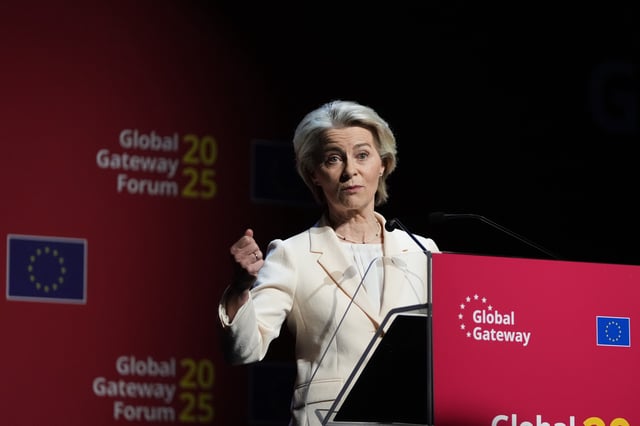
European Commission President Ursula von der Leyen speaks during the opening address at the Global Gateway Forum in Brussels, Thursday, Oct. 9, 2025. (AP Photo/Virginia Mayo)
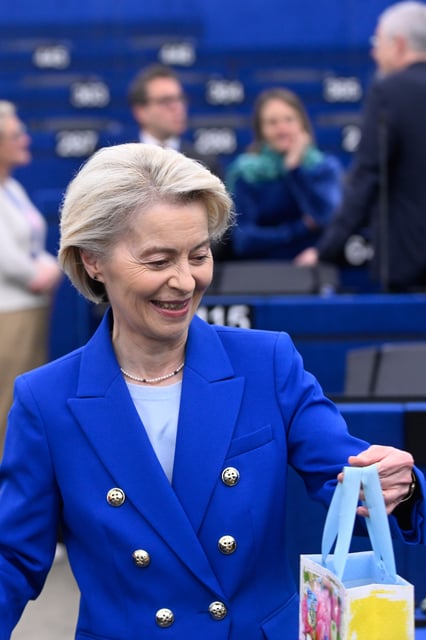
European Commission president Ursula von der Leyen holds a gift she got for her birthday before delivering her statement on EU response to recent Russian violations of the EU Member States' airspace and critical infrastructure, Wednesday, Oct. 8, 2025 at the European Parliament in Strasbourg, eastern France. (AP Photo/Pascal Bastien)
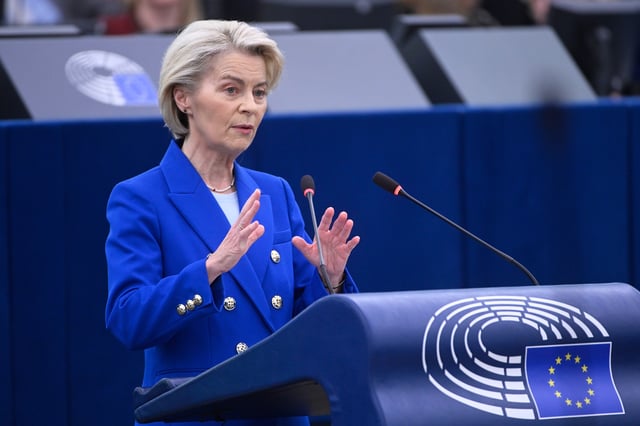
European Commission president Ursula von der Leyen delivers her statement on EU response to recent Russian violations of the EU Member States' airspace and critical infrastructure, Wednesday, Oct. 8, 2025 at the European Parliament in Strasbourg, eastern France. (AP Photo/Pascal Bastien)
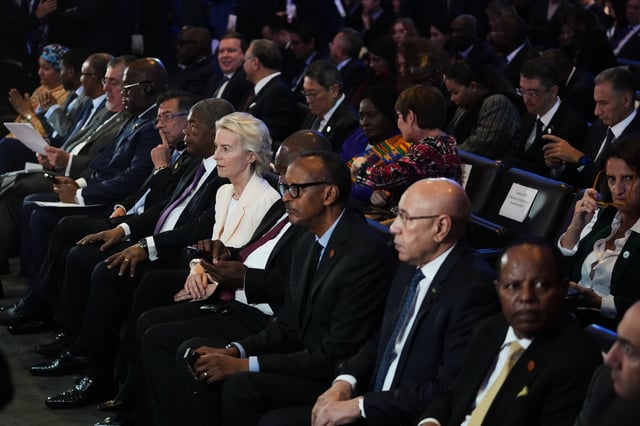
European Commission President Ursula von der Leyen, center, sits with other world leaders during the Global Gateway Forum in Brussels, Thursday, Oct. 9, 2025. (AP Photo/Virginia Mayo)

Overview

  • The European Parliament rejected censure motions from far-right and hard-left groups, with 378 and 383 votes backing Ursula von der Leyen, short of the two-thirds needed to unseat her.
  • EPP lawmakers are threatening to sink the Commission’s budget overhaul that would pool farm and cohesion funds under national control, prompting the Commission to set up working groups with key EPP MEPs.
  • The EPP is split on the EU’s proposed 2040 emissions target, with no majority for a 90% cut, freezing internal talks until EU leaders meet on October 23 and delaying committee votes ahead of COP30.
  • Parliament’s leverage has grown after 2024 rule changes that lowered the threshold to table censure motions to 72 signatures and a revised framework giving MEPs modestly increased oversight of the Commission.
  • Trade remains a flashpoint as critics target the U.S. tariff arrangement and the proposed Mercosur deal, both headed for parliamentary votes with outcomes unclear.